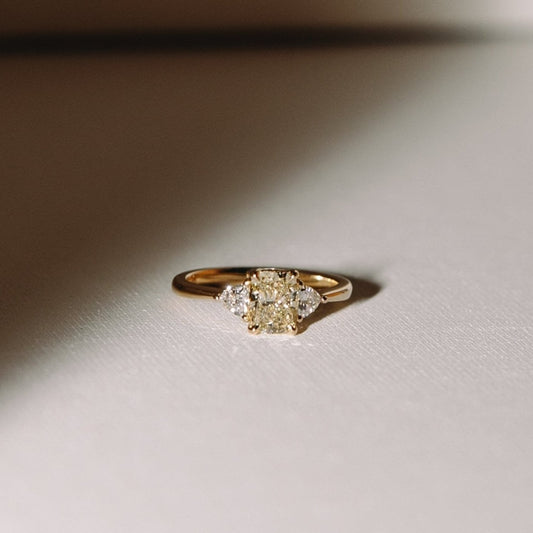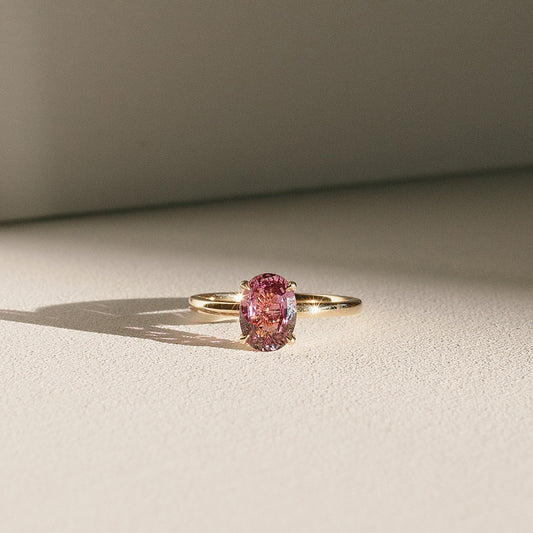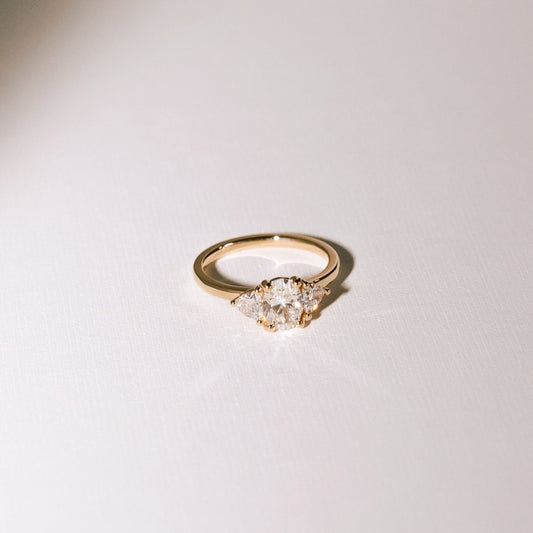

If you were born in May, your birthstone is one of the most coveted gemstones in history. Emeralds have adorned the necks of Egyptian queens, and remained a symbol of renewal, love, and rare natural beauty for thousands of years.
But where exactly do emeralds come from? Here's the full story.
Born deep underground
Emeralds are a variety of the mineral beryl and has the presence of trace amounts of chromium, and sometimes vanadium, which give it that rich, saturated green.
The formation of an emerald is a geological love story.
The process unfolds over millions of years, as hydrothermal fluids carry beryllium through fractures in the earth, eventually cooling and crystallising into the hexagonal prisms we cut and polish into gemstones.
The world's great emerald origins
Colombia
The world's most celebrated source. Known for warm, slightly yellowish-green hues and exceptional saturation.
Zambia
Rising to prominence in recent decades, Zambian emeralds tend to be deeper and cooler in tone, a rich blue-green with high clarity.
Brazil
Often lighter and slightly more yellowish than Colombian stones, but produced in large quantities.
Zimbabwe
Produces small but intensely saturated stones with a vivid, pure green.
A stone steeped in history
The ancient Egyptians mined emeralds near the Red Sea as far back as 1500 BCE. Cleopatra was famously obsessed with them. She claimed the mines near her kingdom as her personal property, and gifted emeralds carved with her likeness to foreign dignitaries. To her, emeralds weren't just beautiful; they were power.
The Spanish conquistadors, upon arriving in South America in the 16th century, found emeralds in abundance, far larger and finer than anything Europe had seen. They quickly overtook the Egyptian sources, and Colombian emeralds flooded the courts of Europe and Asia, transforming the gem trade forever. Emperors in India became particularly obsessed, commissioning enormous emeralds to be carved with sacred texts and prayers.
As May's birthstone, emerald has long been associated with spring, fertility, and renewal. The Romans dedicated it to Venus, goddess of love and beauty, an association that has never quite faded.
The beauty of imperfection
Unlike diamonds, which are graded heavily on clarity, emeralds are almost universally included. Their internal fractures and crystal inclusions are considered part of their identity, a fingerprint from the earth. A completely inclusion-free emerald is exceptionally rare and would raise questions about whether it's been treated.
In fact, the majority of emeralds on the market are treated with cedarwood oil or resin to fill surface-reaching fractures and improve clarity. This is an accepted and longstanding practice in the gem trade, and a natural part of working with this particular stone.

Something to consider: emeralds are a softer stone
This is one thing we feel strongly about sharing honestly with our clients. Emeralds rank 7.5 to 8 on the Mohs scale of hardness, significantly lower than diamonds (10), and lower than sapphires (9). That difference matters in everyday life.
Emeralds are also more susceptible to chipping than their hardness number suggests, because of the natural fractures and inclusions within them. A stone set in a ring, especially an engagement ring or something worn daily, is subject to knocks and impacts that can, over time, cause damage. The treatments most emeralds undergo also require care: harsh ultrasonic cleaners, for example, can remove the oil or resin filling the fractures, dulling the stone's appearance.
For these reasons, at Ma Folie, we recommend our clients consistently gravitate towards green sapphire as the most beautiful and practical alternative when it comes to engagement rings.
Why green sapphire is the alternative we love
Green sapphires come in a remarkable range of greens, from soft minty tones to deep forest hues with the durability and reliability of corundum, the hardest natural gemstone after diamond.
At a 9 on the Mohs scale, a green sapphire can genuinely withstand the rigours of daily wear. There are no fractures to be careful around, no special cleaning requirements.
Some of our clients are drawn to the idea of an emerald, and we completely understand why. The colour, the history, the romance are all irresistible. But when they hold a green sapphire alongside an emerald, they're often struck by how vivid and saturated a sapphire's colour can be, without any of the compromises. It's a stone that's ready to be worn every single day, and to be passed down through generations.
Not sure where to start?
If you're still figuring out what engagement ring feels right for you, we're happy to help.
Browse our sapphire collection rings, or book a consultation and we'll guide you through it.