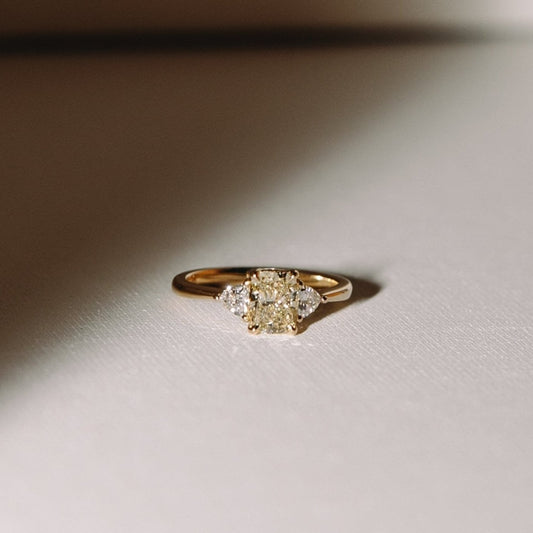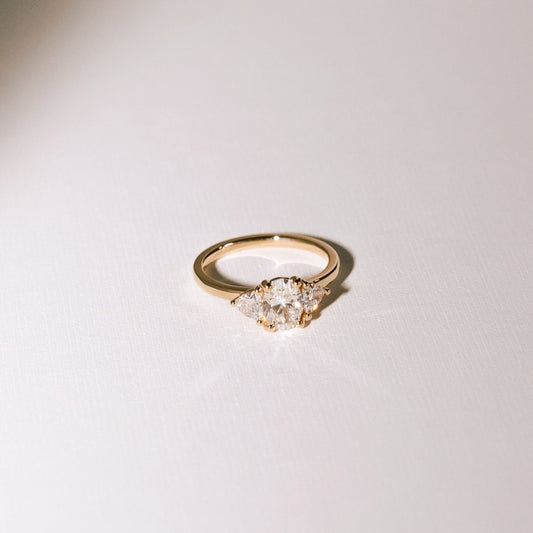

The short answer is no. Not by looking, holding it, and even with a trained eye.
Lab grown diamonds and natural diamonds are chemically, physically, and optically identical. Both are pure carbon. Both are a 10 on the Mohs hardness scale. There is nothing visible that separates one from the other.
What a Jeweler Sees
A jeweler looking at your ring cannot tell whether the diamond is lab grown or natural by inspection alone. The Gemological Institute of America (GIA), one of the world's most respected diamond grading authorities, states plainly that traditional gemological observations and instrumentation cannot distinguish between the two. Detection requires specialized scientific equipment.
How It Can Be Detected
The differences between lab and natural diamonds exist at a microscopic and atomic level.
Natural diamonds form over billions of years under the earth, which creates specific types of inclusions. Lab grown diamonds, grown via HPHT (high pressure, high temperature) or CVD (chemical vapor deposition) methods, can contain different inclusions, including trace metallic particles from the growth process. These are only visible under magnification.
Some lab grown diamonds also react differently to UV light during fluorescence testing. Spectroscopically, most gem quality lab grown diamonds fall into a category called Type IIa, which fewer than 2% of natural diamonds belong to. Neither of these is something detectable by eye.
The most practical tell is the girdle inscription. Most lab grown diamonds sold today carry a microscopic laser inscription on the thin edge of the stone, a serial number paired with the words "lab grown." You need magnification to see it.
Your Certificate Tells You
Every lab grown diamond at Ma Folie comes with an International Gemological Institute (IGI) report that clearly states the diamond's origin alongside its cut, colour, clarity, and carat weight. You always know exactly what you have.
The Bottom Line
No one will look at your ring and know whether the diamond was grown in a lab or pulled from the earth. The only way to distinguish them is through specialized equipment or a grading certificate. The diamond looks identical because, in every meaningful way, it is.
If you want to browse our designs, explore the lab diamond rings collection. Or if you'd prefer to see them in person, book a consultation at our Vancouver studio.